Doté d'une commande simple à bouton unique et d'un écran ACL rétroéclairé facile à lire pour assurer une visualisation claire des lectures de niveaux de gaz, des conditions d'alarme et de la durée de vie de la pile. Comprend un capteur de gaz ammoniac (NH3).
Doté d'une commande simple à bouton unique et d'un écran ACL rétroéclairé facile à lire pour assurer une visualisation claire des lectures de niveaux de gaz, des conditions d'alarme et de la durée de vie de la pile. Comprend un capteur de gaz ammoniac (NH3).
Gasman with Ammonia Sensor
Gasman monitor is available in a variety of gas configurations to meet your individual application. With its small size and light weight they are comfortable to wear all day long. Features visible flashing LEDs and loud audible and vibrating alarms to quickly alert the wearer to potential gas hazards. Data is recorded by the monitor and can be downloaded to a PC or printer using the adapter/PC interface (sold separately).
Caractéristiques
Please note: Precautions must be taken when using pumps or manual aspirators. Some hose materials are not usable with readily absorbent gases.
Applications
| Gamme de NH3 | 0 à 100 ppm |
| Alarmes | Audible: 95 dB; plusieurs options d'alarme vous permettent de sélectionner des tonalités distinctives pour différents niveaux d'alarme Visible: DEL clignotantes bicolores rouge/bleu en cas de danger de gaz; alarme vibrante interne |
| Journalisation des données | Journalisation complète des données chronométrées avec taux d'échantillonnage réglable, réglé par défaut sur un intervalle de 1 minute 900 heures de stockage à un intervalle de 1 minute (54,000 journaux), > 4800 événements |
| Pile | Pile au lithium rechargeable pour tous les types de gaz Pile au lithium non rechargeable pour les gaz toxiques et l'oxygène (excluant le CO2) |
| Temps de fonctionnement | Rechargeable: 12 heures minimum pour l'unité de gaz inflammables Non rechargeable: Jusqu'à 2 ans |
| Température de fonctionnement | -20 à 65°C (-4 à 149°F) |
| Humidité | 20 à 90% RH |
| Indice de protection | IP65 |
| Homologations | Europe: Toxique ou O2: ATEX II 1 g (0.04 oz) Ex ia IIC T4 Ga (-20°C (-4°F) ≤ Ta ≤ 65°C (149°F)) BASEEFA04ATEX0384 Inflammable: ATEX II 2 g (0.07 oz) Ex ia d IIC T4 Gb (-20°C (-4°F) ≤ Ta ≤ 65°C (149°F)) BASEEFA04ATEX0383 International: Toxique ou O2: IECEx BAS05.0039; Inflammable: IECEx BAS05.0038 Amérique du Nord: CSA Classe 1 Groupes A, B, C, D Division 1 |
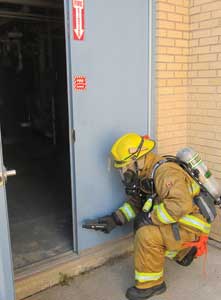 Gas detection has come a long way over the past few years. Now you can find detectors that continuously run, require little to no calibration and offer very little maintenance. This life saving tool can notify first responders and firefighters of a danger as soon as they walk through a door. Since exposure to gas can affect firefighters rapidly, this is a must have tool to accompany on any emergency call.
Portable gas detectors are used to monitor the atmosphere around an emergency professional and can be worn on clothing, attached to a belt or a backpack. These units are battery operated and transmit warnings via audible and visible signals when gases reach dangerous levels. Gas detectors can be used to identify combustible, flammable and toxic gases, and oxygen depletion depending on the need.
There are essentially two types of gas detectors: a single gas detector that is equipped to detect any single-gas hazard, or a multi-gas detector that is usually equipped with LEL (lower explosive limit), O2 (oxygen), CO (carbon monoxide) and H2S (hydrogen sulfide) sensors. This will simultaneously monitor several gases and combustibles.

Some common applications used in emergency situations are:
Gas detectors that can read LEL should be used to determine where the hot zone is. Any LEL reading on a detector indicates the presence of gas and a potential hazard. Using these meters in emergency situations can be the difference between life and death.
Personal gas detectors have gotten a lot smaller over the years but the need is greater than ever. Advancements in technology have made these tools economical for all first responders, emergency personnel and fire fighters to have on every emergency call.
| Gamme de NH3 | 0 à 100 ppm |
| Alarmes | Audible: 95 dB; plusieurs options d'alarme vous permettent de sélectionner des tonalités distinctives pour différents niveaux d'alarme Visible: DEL clignotantes bicolores rouge/bleu en cas de danger de gaz; alarme vibrante interne |
| Journalisation des données | Journalisation complète des données chronométrées avec taux d'échantillonnage réglable, réglé par défaut sur un intervalle de 1 minute 900 heures de stockage à un intervalle de 1 minute (54,000 journaux), > 4800 événements |
| Pile | Pile au lithium rechargeable pour tous les types de gaz Pile au lithium non rechargeable pour les gaz toxiques et l'oxygène (excluant le CO2) |
| Temps de fonctionnement | Rechargeable: 12 heures minimum pour l'unité de gaz inflammables Non rechargeable: Jusqu'à 2 ans |
| Température de fonctionnement | -20 à 65°C (-4 à 149°F) |
| Humidité | 20 à 90% RH |
| Indice de protection | IP65 |
| Homologations | Europe: Toxique ou O2: ATEX II 1 g (0.04 oz) Ex ia IIC T4 Ga (-20°C (-4°F) ≤ Ta ≤ 65°C (149°F)) BASEEFA04ATEX0384 Inflammable: ATEX II 2 g (0.07 oz) Ex ia d IIC T4 Gb (-20°C (-4°F) ≤ Ta ≤ 65°C (149°F)) BASEEFA04ATEX0383 International: Toxique ou O2: IECEx BAS05.0039; Inflammable: IECEx BAS05.0038 Amérique du Nord: CSA Classe 1 Groupes A, B, C, D Division 1 |
Gas detection has come a long way over the past few years. Now you can find detectors that continuously run, require little to no calibration and offer very little maintenance. This life saving tool can notify first responders and firefighters of a danger as soon as they walk through a door. Since exposure to gas can affect firefighters rapidly, this is a must have tool to accompany on any emergency call.
Portable gas detectors are used to monitor the atmosphere around an emergency professional and can be worn on clothing, attached to a belt or a backpack. These units are battery operated and transmit warnings via audible and visible signals when gases reach dangerous levels. Gas detectors can be used to identify combustible, flammable and toxic gases, and oxygen depletion depending on the need.
There are essentially two types of gas detectors: a single gas detector that is equipped to detect any single-gas hazard, or a multi-gas detector that is usually equipped with LEL (lower explosive limit), O2 (oxygen), CO (carbon monoxide) and H2S (hydrogen sulfide) sensors. This will simultaneously monitor several gases and combustibles.
Some common applications used in emergency situations are:
Gas detectors that can read LEL should be used to determine where the hot zone is. Any LEL reading on a detector indicates the presence of gas and a potential hazard. Using these meters in emergency situations can be the difference between life and death.
Personal gas detectors have gotten a lot smaller over the years but the need is greater than ever. Advancements in technology have made these tools economical for all first responders, emergency personnel and fire fighters to have on every emergency call.