- Sign In
- |
- Sign Up
- |
- My Quote (0)
- |
- CART (0)

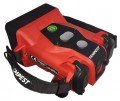
Thermal imager for firefighters. Features a 320 x 240 60Hz infared detector with a -20 to 650°C temperature range. The K55 also offers in-camera video storage. Features a 2x digital zoom.
Thermal imager for firefighters. Features a 320 x 240 60Hz infared detector with a -20 to 650°C temperature range. The K55 also offers in-camera video storage. Features a 2x digital zoom.
NO LONGER AVAILABLE!
This product is no longer available.
There is no direct replacement, however we recommend the:


Not what you're looking for? Let’s do a search and help you find what you need.
 Description
 Specifications
 Powerful Tools
 Included
 Videos
 Resources
 Accessories
 Forum
Forum Customer Reviews
Affordable K-Series TICs offer new, easier ways to see more clearly in the darkest, smokiest environments by showing big, bright FLIR images to help you maneuver more strategically, stay better oriented, and find victims faster.
FSX - Flexible Scene Enhancement
Details in the thermal image are enhanced through digital image processing inside the camera.The result is an ultra-sharp thermal image that shows more detail. FSX makes it easier for firefighters to find their way in smoke filled rooms. Even in scenes with extreme temperature dynamics that are typical for a firefighting environment.
Features
| Imaging and Optical Data | |
| IR Resolution | 320 × 240 pixels |
| Thermal Sensitivity/NETD | < 30 mK @ +30°C (+86°F) |
| Field of View (FOV) / Minimum Focus Distance | 51° × 38°/ NA fixed focus. See DOF |
| Depth of Field | 0.84 m to inf. (33 in. to inf.) |
| Spatial Resolution (IFOV) | 2.8 mrad |
| F-number | 1.25 |
| Image Frequency | 60 Hz |
| Focus | Fixed |
| Zoom | 2× digital zoom |
| Detector Data | |
| Focal Plane Array (FPA) / Spectral Range | Uncooled microbolometer / 7.5–13 µm |
| Image Presentation | |
| Display | 4" LCD, 320 × 240 pixels, backlit |
| Auto Range | Yes, mode dependent. Configurable through FLIR Tools SW |
| Contrast Optimization | Digital image enhancement through FSX |
| Image Presentation Modes | |
| Image Modes | IR Image TI Basic NFPA Fire Fighting Mode Black and White Fire Fighting Mode Fire Mode Search and Rescue Mode Heat Detection Mode Thumbnail Gallery |
| Infrared Image | IR image, presentation mode dependent. Configurable through FLIR Tools SW |
| Measurement | |
| Object Temperature range | –20 to 150°C (-4 to 302°F) 0 to 650°C (32 to 1202°F) |
| Accuracy | ±4°C (±7.2°F) or ±4% of reading, for ambient temperature 10 to 35°C (50 to 95°F) |
| Measurement Analysis | |
| Spotmeter | 1 |
| Automatic Hot/Cold Detection | Heat detection mode (The hottest 2% of the of scene is colorised) |
| Isotherm | Yes, according to NFPA |
| Set-up | |
| Set-up Commands | Local adaptation of units, date and time formats |
| Languages | English |
| Storage of Images | |
| Image Storage | Standard JPEG |
| Storage Media | Internal Flash memory |
| Image Storage Capacity | 200 |
| Image Storage Mode | IR only |
| File Formats | Standard JPEG |
| Image Annotations | |
| Report Generation | Separate PC Software |
| Video Recording in Camera | |
| Non-Radiometric IR-Video Recording | MPEG-4 to internal Flash memory |
| Video Streaming | |
| Non-Radiometric IR-Video Streaming | Uncompressed colorized video using USB |
| Data Communication Interfaces | |
| Interfaces | USB-mini |
| USB | |
| USB | USB Mini-B: Data transfer to and from PC / Uncompressed colorized video |
| Power System | |
| Battery | Li Ion |
| Battery Capacity | 4.4 Ah, at 20 to 25°C (68 to 77°F) |
| Battery Operating Time | Approx. 4 hours at 25°C (77°F) ambient temperature and typical use |
| Charging System | 2-bay charger or optional In-truck charger |
| Charging Time | 2 h to 85% capacity, charging status indicated by LED's |
| Charging Temperature | 0 to 45°C (32 to 113°F) |
| Power Management | Automatic shutdown and sleep mode |
| Start-up Time from Sleep Mode | < 4 sec. |
| Start-up Time | < 17 sec. (IR-image, no GUI) |
Thermal imagers or thermal imaging cameras (TIC) were once restricted to use by the military, however, this technology has been declassified and is now becoming a very useful tool for the fire service. Thermal Imaging Equipment can provide first responders with critical information to size up a fire incident, track fire growth, and to locate victims, other first responders, and egress routes. The need for standardized performance evaluation methods arise as TIC use increases and fire fighters begin to consider them essential equipment. These devices represent a significant investment.
The environment encountered by fire fighters varies, depending on the nature of the fire scenario. Decades of fire testing have shown that the gas temperature in a naturally ventilated burning room stratifies, due to buoyancy, into a hot upper layer that contains combustion byproducts and a cooler lower layer comprised mainly of ambient air. The time-varying severity of conditions in the room of fire origin and adjacent or nearby rooms will change depending on the type and amount of materials burning, thermal properties of the room surfaces, the ventilation conditions, the size of the room, and a number of other factors. As any fire fighter will gladly explain, no two fires are exactly the same. For this reason, incorporating the chaotic and dynamic nature of fire conditions into readily controlled, reproducible, and repeatable tests that will be performed by numerous parties is a difficult task.

TIC In Use
A typical situation in which a TIC is used may involve a residential or commercial fire, where furnishings, structural materials, electrical appliances, or other materials burn in a flaming or smoldering mode. As these commodities burn, smoke and combustion byproducts such as carbon dioxide (CO2) and water (H2O) will be produced in large quantities. In these conditions fire fighters frequently cannot see through the smoke. Sometimes fire fighters are called to an event in which someone suspects that a fire is starting but cannot pinpoint the fire source. In this case there may not be a large amount of smoke, but without a TIC the fire fighter may need to create many holes in walls and ceilings in order to find the problem.


Operating Conditions
There are two basic ways in which operating conditions affect TIC: first, the camera itself must be rugged enough to function in elevated temperatures and humidity, and to withstand other adverse conditions imposed on it by the operational environment and by the fire fighter; and second, the TIC must be capable of producing images that provide useful information to the user. Image quality tests address the ability of the TIC to capture an infrared scene with sufficient sensitivity and detail to enable the user to perform a particular activity, such as searching for a fire victim.
TIC Robustness
During the course of a fire emergency event, a TIC may be subjected to high pressure salt or fresh water spray, it may be submerged in water, it may tumble down a flight of stairs, it may fall from a height of 2 meters or more, and it may spend time rolling around the floor of a fire truck on the way to the event. Then there are the effects of the fire to consider: flames and heat. The TIC should not interfere with or be interfered with by other electronic equipment. It should not be a shock hazard to the user and it should not be the source of an ignition or explosion. The TIC robustness performance for all of these operational conditions can be evaluated using established laboratory-based test methods, in some cases with slight modification.
Image Quality Evaluating the performance of TIC with respect to image quality is more complicated than evaluating TIC robustness. Established laboratory-based test methods have not been developed for the special high-heat, wide- temperature-range conditions in which fire fighters routinely operate. The field of view of the TIC must be wide enough that a fire fighter can use it to navigate in an unfamiliar structure with visibility of less than 15 cm and still be able to see enough detail in the image to understand what is there. Given a minimum field of view, the TIC must still be capable of providing sufficient spatial resolution for the user to identify important objects. There may easily be situations in which both water and flames are present, which challenges the ability of the TIC to respond across a wide range of temperatures (dynamic range). In this situation, the fire fighter may be looking for another fire fighter, a civilian victim, or an egress route and would need to see these objects of intermediate temperature in spite of the flames and/or water. In another scenario a fire fighter may need to see relatively small differences in ambient temperature, for example when looking at the level of hazardous material in a container to determine which container is leaking. At higher temperatures, a fire fighter may look at a hot ceiling for the most appropriate place to vent. For these operations the TIC must have a thermal sensitivity that permits enough contrast in the image for the user to perform the task.
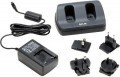
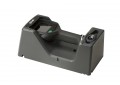
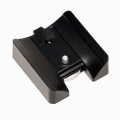
Click on a category to view a selection of compatible accessories with the FLIR K55 Thermal Imaging Camera (TIC) with FSX for Firefighters with 2x Zoom, 76800 Pixels (320 x 240).



| Imaging and Optical Data | |
| IR Resolution | 320 × 240 pixels |
| Thermal Sensitivity/NETD | < 30 mK @ +30°C (+86°F) |
| Field of View (FOV) / Minimum Focus Distance | 51° × 38°/ NA fixed focus. See DOF |
| Depth of Field | 0.84 m to inf. (33 in. to inf.) |
| Spatial Resolution (IFOV) | 2.8 mrad |
| F-number | 1.25 |
| Image Frequency | 60 Hz |
| Focus | Fixed |
| Zoom | 2× digital zoom |
| Detector Data | |
| Focal Plane Array (FPA) / Spectral Range | Uncooled microbolometer / 7.5–13 µm |
| Image Presentation | |
| Display | 4" LCD, 320 × 240 pixels, backlit |
| Auto Range | Yes, mode dependent. Configurable through FLIR Tools SW |
| Contrast Optimization | Digital image enhancement through FSX |
| Image Presentation Modes | |
| Image Modes | IR Image TI Basic NFPA Fire Fighting Mode Black and White Fire Fighting Mode Fire Mode Search and Rescue Mode Heat Detection Mode Thumbnail Gallery |
| Infrared Image | IR image, presentation mode dependent. Configurable through FLIR Tools SW |
| Measurement | |
| Object Temperature range | –20 to 150°C (-4 to 302°F) 0 to 650°C (32 to 1202°F) |
| Accuracy | ±4°C (±7.2°F) or ±4% of reading, for ambient temperature 10 to 35°C (50 to 95°F) |
| Measurement Analysis | |
| Spotmeter | 1 |
| Automatic Hot/Cold Detection | Heat detection mode (The hottest 2% of the of scene is colorised) |
| Isotherm | Yes, according to NFPA |
| Set-up | |
| Set-up Commands | Local adaptation of units, date and time formats |
| Languages | English |
| Storage of Images | |
| Image Storage | Standard JPEG |
| Storage Media | Internal Flash memory |
| Image Storage Capacity | 200 |
| Image Storage Mode | IR only |
| File Formats | Standard JPEG |
| Image Annotations | |
| Report Generation | Separate PC Software |
| Video Recording in Camera | |
| Non-Radiometric IR-Video Recording | MPEG-4 to internal Flash memory |
| Video Streaming | |
| Non-Radiometric IR-Video Streaming | Uncompressed colorized video using USB |
| Data Communication Interfaces | |
| Interfaces | USB-mini |
| USB | |
| USB | USB Mini-B: Data transfer to and from PC / Uncompressed colorized video |
| Power System | |
| Battery | Li Ion |
| Battery Capacity | 4.4 Ah, at 20 to 25°C (68 to 77°F) |
| Battery Operating Time | Approx. 4 hours at 25°C (77°F) ambient temperature and typical use |
| Charging System | 2-bay charger or optional In-truck charger |
| Charging Time | 2 h to 85% capacity, charging status indicated by LED's |
| Charging Temperature | 0 to 45°C (32 to 113°F) |
| Power Management | Automatic shutdown and sleep mode |
| Start-up Time from Sleep Mode | < 4 sec. |
| Start-up Time | < 17 sec. (IR-image, no GUI) |
Thermal imagers or thermal imaging cameras (TIC) were once restricted to use by the military, however, this technology has been declassified and is now becoming a very useful tool for the fire service. Thermal Imaging Equipment can provide first responders with critical information to size up a fire incident, track fire growth, and to locate victims, other first responders, and egress routes. The need for standardized performance evaluation methods arise as TIC use increases and fire fighters begin to consider them essential equipment. These devices represent a significant investment.
The environment encountered by fire fighters varies, depending on the nature of the fire scenario. Decades of fire testing have shown that the gas temperature in a naturally ventilated burning room stratifies, due to buoyancy, into a hot upper layer that contains combustion byproducts and a cooler lower layer comprised mainly of ambient air. The time-varying severity of conditions in the room of fire origin and adjacent or nearby rooms will change depending on the type and amount of materials burning, thermal properties of the room surfaces, the ventilation conditions, the size of the room, and a number of other factors. As any fire fighter will gladly explain, no two fires are exactly the same. For this reason, incorporating the chaotic and dynamic nature of fire conditions into readily controlled, reproducible, and repeatable tests that will be performed by numerous parties is a difficult task.
TIC In Use
A typical situation in which a TIC is used may involve a residential or commercial fire, where furnishings, structural materials, electrical appliances, or other materials burn in a flaming or smoldering mode. As these commodities burn, smoke and combustion byproducts such as carbon dioxide (CO2) and water (H2O) will be produced in large quantities. In these conditions fire fighters frequently cannot see through the smoke. Sometimes fire fighters are called to an event in which someone suspects that a fire is starting but cannot pinpoint the fire source. In this case there may not be a large amount of smoke, but without a TIC the fire fighter may need to create many holes in walls and ceilings in order to find the problem.
Operating Conditions
There are two basic ways in which operating conditions affect TIC: first, the camera itself must be rugged enough to function in elevated temperatures and humidity, and to withstand other adverse conditions imposed on it by the operational environment and by the fire fighter; and second, the TIC must be capable of producing images that provide useful information to the user. Image quality tests address the ability of the TIC to capture an infrared scene with sufficient sensitivity and detail to enable the user to perform a particular activity, such as searching for a fire victim.
TIC Robustness
During the course of a fire emergency event, a TIC may be subjected to high pressure salt or fresh water spray, it may be submerged in water, it may tumble down a flight of stairs, it may fall from a height of 2 meters or more, and it may spend time rolling around the floor of a fire truck on the way to the event. Then there are the effects of the fire to consider: flames and heat. The TIC should not interfere with or be interfered with by other electronic equipment. It should not be a shock hazard to the user and it should not be the source of an ignition or explosion. The TIC robustness performance for all of these operational conditions can be evaluated using established laboratory-based test methods, in some cases with slight modification.
Image Quality Evaluating the performance of TIC with respect to image quality is more complicated than evaluating TIC robustness. Established laboratory-based test methods have not been developed for the special high-heat, wide- temperature-range conditions in which fire fighters routinely operate. The field of view of the TIC must be wide enough that a fire fighter can use it to navigate in an unfamiliar structure with visibility of less than 15 cm and still be able to see enough detail in the image to understand what is there. Given a minimum field of view, the TIC must still be capable of providing sufficient spatial resolution for the user to identify important objects. There may easily be situations in which both water and flames are present, which challenges the ability of the TIC to respond across a wide range of temperatures (dynamic range). In this situation, the fire fighter may be looking for another fire fighter, a civilian victim, or an egress route and would need to see these objects of intermediate temperature in spite of the flames and/or water. In another scenario a fire fighter may need to see relatively small differences in ambient temperature, for example when looking at the level of hazardous material in a container to determine which container is leaking. At higher temperatures, a fire fighter may look at a hot ceiling for the most appropriate place to vent. For these operations the TIC must have a thermal sensitivity that permits enough contrast in the image for the user to perform the task.
Click on a category to view a selection of compatible accessories with the FLIR K55 Thermal Imaging Camera (TIC) with FSX for Firefighters with 2x Zoom, 76800 Pixels (320 x 240).